




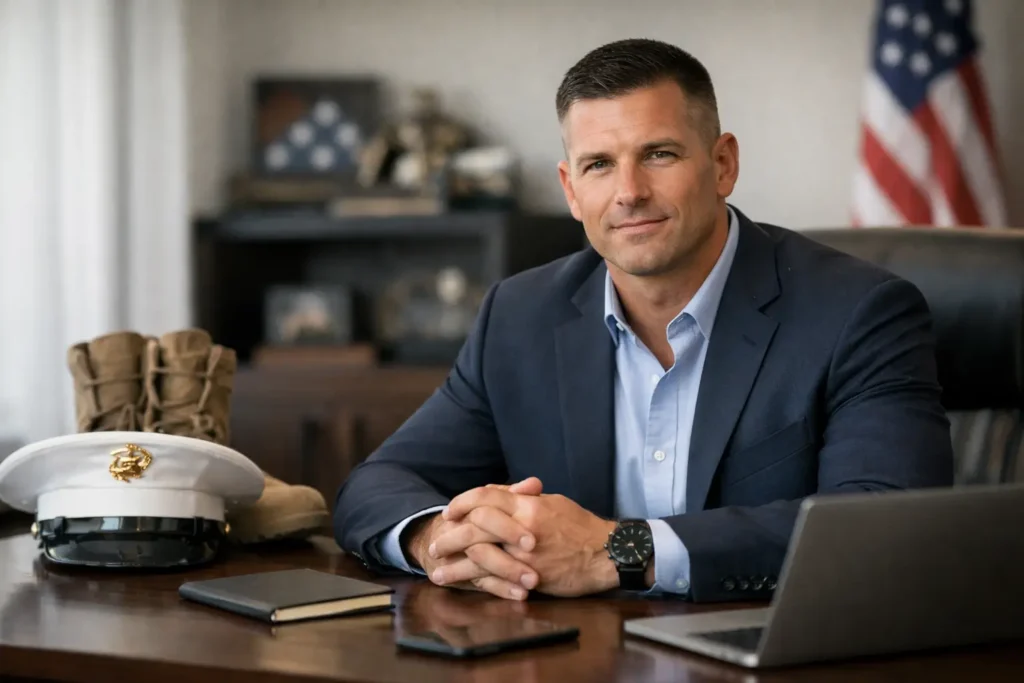
The day you take the uniform off, nobody hands you a clean map. They thank you for your service, shake your hand, and send you into a world that talks a lot about opportunity but says very little about identity. That is where the Marine veteran entrepreneur journey really starts – not with a business license, not with a logo, but with the moment you realize rank is gone and results are now your only currency.
I have lived that shift. And if you are a veteran building a business, or a founder trying to lead with discipline instead of noise, I want to tell you the truth plain. The transition from Marine to entrepreneur is not hard because veterans lack grit. It is hard because grit alone does not build a company. It helps you survive. It does not automatically teach you how to scale, delegate, sell, or confront your own blind spots.
That distinction matters.
What the Marine veteran entrepreneur journey really tests
A lot of people assume veterans have a built-in advantage in business. There is some truth there. Marines know how to operate under pressure, commit to a mission, and keep moving when comfort is off the table. That gives you a stronger starting point than most.
But business does not reward effort the way the military often does. In the Corps, hard work, discipline, and chain of command mean something immediately. In business, you can outwork everybody in the room and still lose because your offer is muddy, your systems are weak, or your leadership style is built for compliance instead of buy-in.
That hits veterans hard because it feels unfair at first. You did what you were trained to do. You showed up early, stayed late, carried the load, and expected performance to create momentum. Then the market answered back with something brutal – nobody owes you traction.
That is not disrespect. That is business.
The real test is whether you can stop treating every obstacle like a fight to win through force. Some problems need force. Most business problems need clarity. If your team is confused, more intensity will not fix it. If your calendar is chaos, motivation will not fix it. If your company depends on your presence every hour of every day, you do not own a business yet. You own a job with overhead.
The identity shift nobody prepares you for
The hardest part of the Marine veteran entrepreneur journey is usually not strategy. It is identity.
In the military, your role is defined. Your standards are visible. Your mission has context bigger than yourself. There is structure around your day, your language, and your place in the team. When you become an entrepreneur, all that structure disappears unless you build it yourself.
That sounds freeing until you realize how many people misuse freedom.
I have seen veterans leave service with discipline in their body but confusion in their head. They know how to execute, but they have not yet decided who they are without the institution. So they chase business the same way some people chase titles – hoping success will settle the identity question.
It will not.
If you do not know who you are, entrepreneurship will expose it. It will amplify every insecurity, every ego problem, every excuse you thought you buried. Business has a way of introducing you to yourself fast.
That is why I do not romanticize the veteran founder path. I respect it, but I do not dress it up. Some veterans build strong companies because they learn to translate discipline into ownership. Others stay stuck because they want business to feel like the military, and it never will.
Leadership changes when nobody has to follow you
This is where a lot of former Marines get humbled. In uniform, leadership carries institutional authority. Out here, people can quit, ignore you, underperform, or smile in your face while they mentally check out.
That does not mean standards go away. It means standards have to be supported by trust, communication, and systems.
Too many veteran entrepreneurs try to lead a company with personal force alone. They become the engine, the enforcer, and the emotional center of every decision. That works for a season, especially in a small operation. Then growth exposes the flaw. The team waits for the founder to speak before moving. Problems pile up at the top. Accountability becomes emotional instead of operational.
You are not building a mission-ready business if everybody depends on your mood, your memory, or your presence.
Real leadership in business means creating a standard that survives your bad day. It means people know what good looks like without you repeating it every morning. It means accountability is built into the culture, not performed as a speech.
That lesson cost me. It costs almost every founder who leads from instinct before structure. The problem is not caring too much. The problem is believing care can substitute for process.
Why discipline helps – and where it can hurt
Discipline is one of the greatest assets a veteran brings into entrepreneurship. Let me be clear about that. Discipline helps you keep commitments, finish what you start, and endure the lonely middle when excitement wears off.
But discipline has a shadow side when it is disconnected from reflection.
You can become disciplined at the wrong things. You can get excellent at overworking, micromanaging, rescuing weak performers, or staying loyal to a broken business model because quitting feels like failure. I have watched founders wear exhaustion like a medal, as if burnout proves commitment.
It does not. It usually proves a lack of design.
This is one of the biggest mindset corrections I had to make. Effort matters, but effort needs direction. If your business runs on sacrifice every week, something is off. Not morally off. Operationally off.
Veterans often have a high tolerance for pain. That can become dangerous in business because pain is not always a signal of nobility. Sometimes it is a signal that your systems are trash, your boundaries are weak, or your decision-making is delayed.
The answer is not to become softer. The answer is to become more honest.
The founder lessons that hit after the hype
Early entrepreneurship rewards hustle. Later entrepreneurship punishes chaos.
That is a hard truth for any founder, but especially for veterans who are used to being able to carry more than most people around them. At first, that capacity looks like an advantage. You can outlast people. You can stay focused. You can absorb pressure.
Then one day your company grows just enough to show you the truth – you cannot personally carry scale.
You need repeatability. You need better conversations. You need a way to make decisions that does not depend on adrenaline. You need to know the difference between ownership and control.
That is where a lot of entrepreneurs stall. Not because they are lazy, but because they are still using survival tools in a season that requires leadership tools.
For me, that became a central part of how I think about founder accountability. Not blame. Not hype. Accountability. The willingness to tell the truth about what your business is actually built on.
If revenue drops, do you know why?
If your team misses, is the issue talent, clarity, or leadership drift?
If you are exhausted, is that because the mission is demanding or because you refuse to let go of tasks you should have outgrown?
Those are not fun questions. They are useful questions.
A better way to frame the journey
The Marine veteran entrepreneur journey is not a straight line from service to success. It is a repeated process of rebuilding. You rebuild identity. You rebuild leadership. You rebuild your relationship with control, uncertainty, and responsibility.
Some seasons call for aggression. Others call for restraint. Some require a thicker skin. Others require enough humility to admit your current way of operating is the problem.
That is why I do not respect polished founder stories that skip the cost. If you are building something real, there will be seasons where your confidence gets punched in the mouth. You will question your model, your timing, and sometimes yourself.
That does not mean you are broken. It means you are in the part of the journey where character gets translated into capacity.
And capacity is what matters.
Not performative toughness. Not borrowed language. Not empty ambition.
Capacity is the ability to lead clearly when pressure rises. To tell the truth when excuses are available. To build systems that support standards. To keep your mission without making your ego the mission.
That is the kind of entrepreneurship I believe in. Hard-earned. Disciplined. Honest.
If you are a veteran building a business right now, do not waste energy trying to prove you are tough enough. You already know how to endure. The better question is whether you are willing to become the kind of founder your next season requires. That answer will shape more than your revenue. It will shape the life your business is building around you.